

4-Act Story Structure: How to Break Your Novel Into Manageable Pieces
☾ ✦ ☽
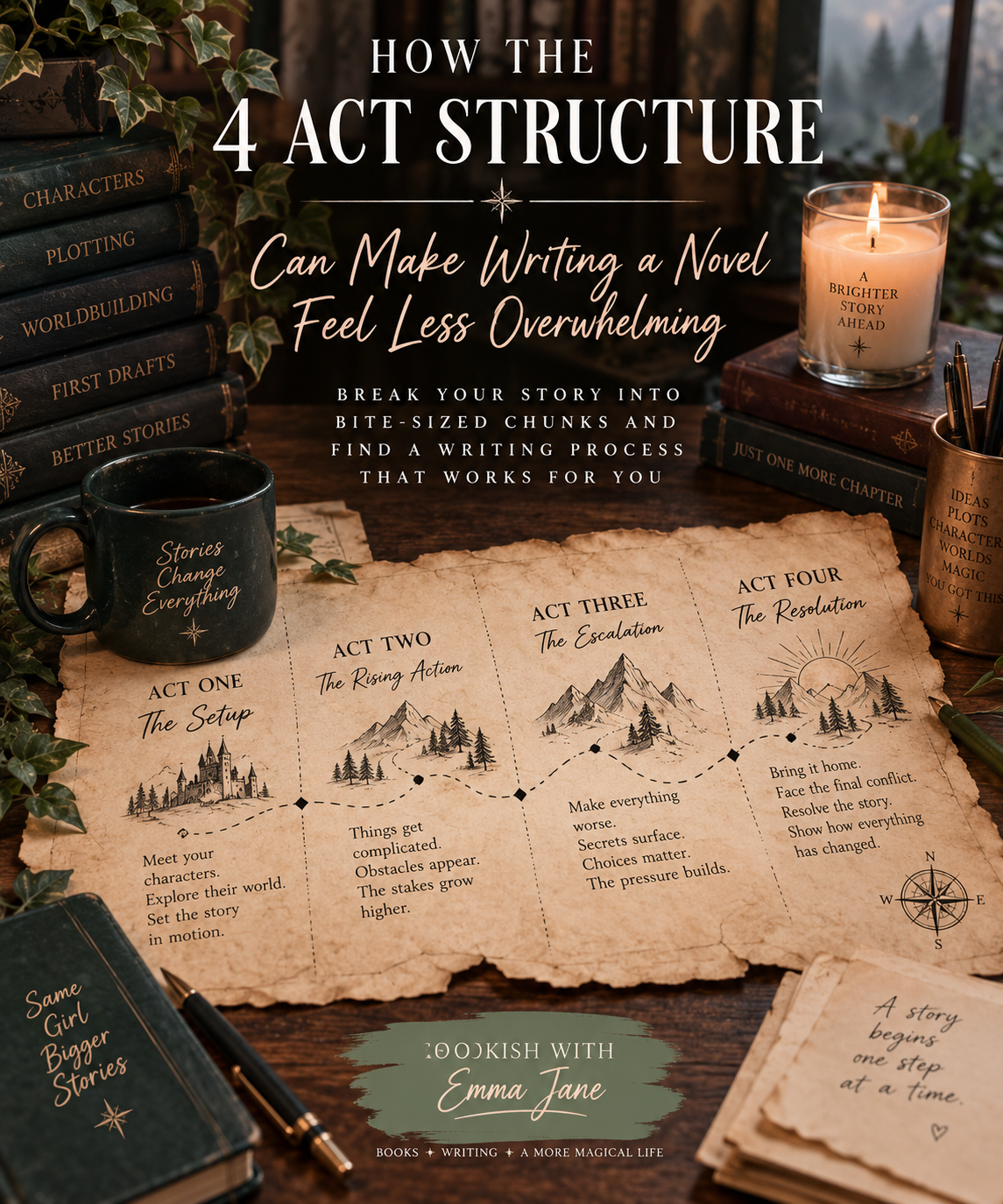
Break your story into bite-sized chunks and find a writing process that works for you.
There is something both exciting and mildly terrifying about deciding you’re going to write a novel.
You have this story living in your head. You know your characters. You can picture certain scenes perfectly. Maybe you already know the dramatic ending that is going to emotionally destroy everyone who reads it.
And then you open a blank document and realize:
“Oh. I actually have to write the whole thing.”
Suddenly, the idea of writing 70,000, 80,000, or even 100,000 words feels a lot bigger than it did when the story was just playing like a movie inside your head.
That is one of the reasons I love breaking a story into smaller pieces.
Instead of looking at my novel as one enormous project that I somehow have to figure out from beginning to end, I can break it into manageable sections. And one of the tools I’ve found helpful for doing that is the 4-Act Story Structure.
Before we get into it, though, I want to make something very clear:
There is NO single correct way to write a book.
Every writer is different. Some of us need detailed outlines before we can write Chapter One. Some writers would rather throw their characters into a situation and see what happens. And then there are those of us somewhere in the middle—we like having a map, but we’re absolutely willing to take an unexpected detour when our characters decide they know better than we do.
What works beautifully for one writer might completely kill another writer’s creativity.
And that’s okay.
Writing structures aren’t rules. They’re tools.
The goal isn’t to force your story into someone else’s formula. It’s to collect enough tools that eventually you figure out how you write best.
So, What Is the 4-Act Structure?
At its simplest, the 4-Act Structure divides your novel into four major sections:
Act One: The Setup
Act Two: The Rising Action
Act Three: The Escalation
Act Four: The Resolution
Instead of sitting down and thinking, I have to figure out an entire novel, you’re giving yourself four smaller pieces to work with.
And personally, that feels a lot less intimidating.
You aren’t trying to answer every question about your book at once.
You’re asking:
What needs to happen in this part of my story?
Once you know that, you can break that act into chapters.
Then scenes.
Then suddenly that giant, terrifying novel isn’t quite so giant anymore.
Act One: Setting Everything in Motion
Act One introduces us to your character’s world before everything completely falls apart.
Because let’s be real—something is probably about to go terribly wrong.
This is where we meet your main character, understand what their normal life looks like, learn what they want or need, and start seeing the problems hiding beneath the surface.
Eventually, something happens that forces your character out of that normal world and into the actual story.
When I’m thinking about Act One, I like questions such as:
Who is my character at the beginning of this story?
What do they want?
What are they missing?
What is standing in their way?
What happens that makes it impossible for life to continue the way it has been?
You don’t necessarily need every chapter planned.
You just need to know where you’re starting and what needs to happen before your character crosses that first major threshold.
Act Two: Things Get Complicated
Your character has entered the story. Now they actually have to deal with it.
Act Two is where they begin pursuing whatever goal has been established, meeting new characters, encountering obstacles, making decisions, and discovering that their problem might be much bigger than they originally thought.
This is also where stories can sometimes start feeling…messy.
You had a fantastic beginning.
You know exactly how you want the book to end.
But that enormous stretch in the middle?
Good luck, soldier!
Breaking the story into acts helps because you’re not trying to fill 40,000 mysterious words between the beginning and ending.
Instead, you’re asking:
What does my character try next?
What gets in their way?
What do they learn?
What relationships are changing?
How are the stakes getting higher?
What needs to happen to push us toward the midpoint of the story?
Now you have smaller problems to solve instead of one giant blank space called THE MIDDLE.
Act Three: Make Everything Worse
This is where you can start being a little mean to your characters.
Okay…maybe very, very, very mean.
The problems introduced earlier in the story begin getting bigger. Choices have consequences. Secrets can come out. Relationships can fracture. Plans fail. Your character may realize that what they originally believed about themselves, another character, or even the entire conflict wasn’t completely true.
The story should be moving toward its biggest confrontation, and your character is being pushed toward the person they need to become in order to face it.
When breaking down Act Three, think about things like:
What could go wrong now?
What does my character stand to lose?
What truth are they avoiding?
How can previous decisions come back to haunt them?
What needs to happen before they’re ready for the final confrontation?
This is usually where I want the pressure to keep building until both my character and the reader are wondering how we’re possibly getting out of this mess.
Don’t worry.
We have one more act.
Hopefully, you have a plan.
Act Four: Bring It Home
Act Four is where everything you’ve been building toward finally comes together.
Your character faces the major conflict.
Questions are answered.
Choices have consequences.
Character arcs reach their turning points.
And those little details you planted earlier in the book can finally pay off.
This doesn’t necessarily mean everything ends happily. Your ending should fit your story.
But the reader should feel like the journey led somewhere.
When planning Act Four, I might ask:
What is the final challenge?
What choice does my character have to make?
How have they changed since Act One?
What plot threads need to be resolved?
What does their world look like afterward?
And, of course:
Do I want to emotionally destroy my readers before I let them leave?
You know.
The important writer questions that really need answering.
From Four Acts to Bite-Sized Pieces
This is where the structure really starts helping me.
Instead of:
Write a novel.
Which is terrifyingly vague.
You now have:
Write Act One.
Still a little big.
So break it down again.
Act One might need ten chapters.
Okay.
Now you’re not writing Act One.
You’re writing Chapter One.
Still struggling?
Break it down again.
What scenes need to happen in Chapter One?
Now your massive novel has turned into:
Write this scene.
That’s manageable.
And once you finish that scene?
You write the next one.
Scene by scene.
Chapter by chapter.
Act by act.
Until one day, all of those little pieces become a novel.
This Is Exactly Why I Created My 4-Act Workbook
Sometimes understanding story structure isn’t the problem. It’s figuring out how to actually apply it to your own story.
That’s why I created my 4-Act Plotting Workbook for the Writer’s Grimoire. Rather than staring at an empty document and trying to somehow hold your entire novel inside your head, the workbook gives you a place to work through your story one piece at a time. You can think through your characters, major plot points, conflicts, turning points, individual acts, and the smaller pieces that connect everything together.
It’s not there to tell you what your story has to look like. It’s there to help you ask questions about your story.
Because sometimes the right question is all you need to get unstuck.
If you’re planning a new novel, struggling with the middle of your current draft, or staring at a collection of scenes wondering how they’re supposed to become an actual book, you can find my 4-Act Plotting Workbook inside the Writer’s Grimoire.
If you want your very own copy, among other amazing free writing resources, check out the link at the very end!
Use what helps.
Change what doesn’t.
Ignore whatever doesn’t work for your story.
The workbook is a tool. Your story is still yours.
You Don’t Have to Follow the Rules
I think this might be the most important part.
Learning about story structure can sometimes make writing feel like there are suddenly a million rules you’re supposed to follow.
Your inciting incident needs to happen here.
Your midpoint needs to happen there.
This percentage of the book should contain this. Your character should have this realization by exactly this point. And while those guidelines can absolutely be helpful, I don’t believe we should become so focused on following a structure that we stop listening to our own stories.
The 4-Act Structure isn’t a set of handcuffs.
It’s a map.
And maps are allowed to have alternate routes.
Maybe you plan all four acts before writing. Maybe you only plan one act at a time. Maybe you write half the book, realize you’ve wandered into the wilderness, and pull out the structure to figure out where you are. Maybe you completely abandon your outline halfway through because your character did something unexpected and somehow made the story better.
That’s writing.
We’re all learning what works for us.
And honestly, your process might even change from one book to another.
The important thing isn’t whether you’re plotting your novel “correctly.”
It’s whether you’re finding a process that helps you keep writing.
Your Novel Doesn’t Have to Feel So Huge
Writing a book is a big project.
There’s really no way around that.
But you don’t have to write an entire novel today.
You don’t even have to figure out the entire novel today.
Figure out the act.
Then the chapter.
Then the scene.
Then write the next sentence.
And eventually, all of those tiny pieces start becoming the story that once existed only inside your head.
So if you’re staring at your manuscript thinking, How am I ever supposed to write this entire thing?
Don’t. Write the next piece. And then keep going.
One act. One chapter. One scene. One sentence at a time.
Ready to Plot Your Story?
You don’t have to figure out your entire novel at once.
Join the Bookish with Emma Jane newsletter and unlock The Writer’s Grimoire—my growing library of free writing resources created to help you plan, write, and build your stories in a way that works for you.
Inside, you’ll find my 4-Act Plotting Workbook to help you take that big, overwhelming novel idea and break it down into manageable acts, chapters, and scenes.
✨ Join the newsletter. Unlock the Grimoire. Start building your story.
